











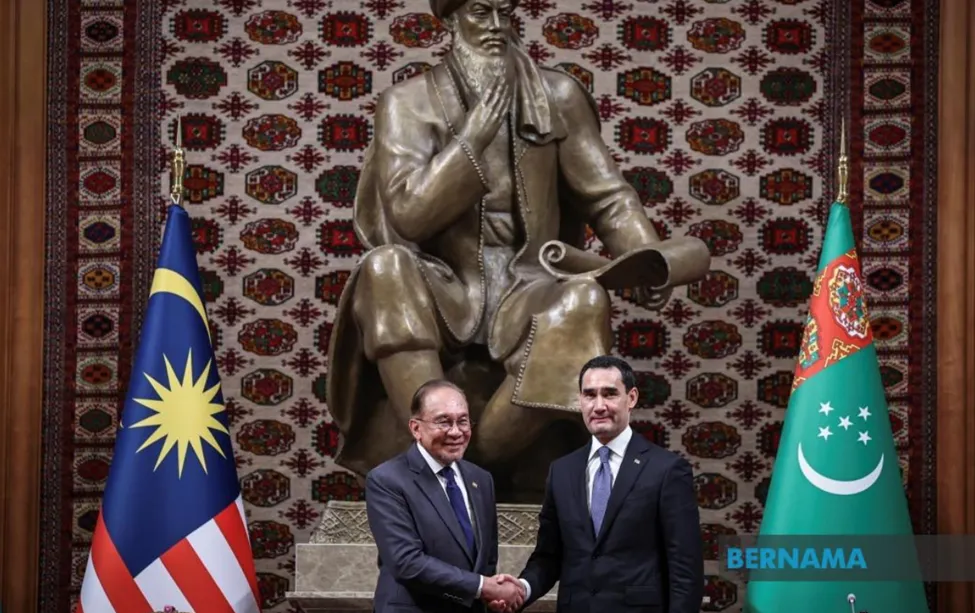
For oil and gas observers, the latest PETRONAS agreements in Turkmenistan should not be read as a routine overseas expansion story. They are a strategic signal.
At the surface, the announcement is straightforward. PETRONAS, through PETRONAS Carigali (Turkmenistan) Sdn Bhd, has signed a Production Sharing Agreement for Offshore Block-19 and Block-20 in the Caspian Sea. It will hold a 100% participating interest in the blocks. PETRONAS also signed a cooperation agreement for 2D seismic studies over northern offshore blocks and a broader framework to explore future collaboration in hydrocarbon development, including potential opportunities linked to the giant Galkynysh gas field, downstream activities, gas processing and gas chemicals.
But in oil and gas, acreage is never just acreage. It represents access. It represents trust. It represents future optionality. Most importantly, it represents confidence by a host government in the technical, financial and diplomatic credibility of the company involved. In this case, it also represents confidence in Malaysia. That is why the presence of Prime Minister Datuk Seri Anwar Ibrahim at the signing ceremony in Ashgabat matters. The agreements were witnessed by Anwar and Turkmenistan President Serdar Berdimuhamedov during the Prime Minister’s official visit. In energy diplomacy, such optics are not cosmetic. They elevate a commercial arrangement into a state-backed strategic understanding. As one regional oil and gas analyst put it, “When a national oil company is given fresh upstream access after three decades in a host country, the message is clear: the relationship has delivered, and the host government wants more of it.” That is exactly what this deal signals.
PETRONAS has operated in Turkmenistan for 30 years. Over that period, it has not merely produced hydrocarbons. It has embedded itself into the country’s energy ecosystem. It has employed more than 1,000 Turkmen nationals, built a workforce that is nearly 90% local, trained hundreds of technicians and supported scholarship pathways through Universiti Teknologi PETRONAS and PETRONAS training facilities. For host governments, that record matters. The upstream industry is capital-intensive, technically demanding and politically sensitive. Countries do not hand out long-term energy opportunities to companies they do not trust.
From an analyst’s perspective, the latest PSA strengthens PETRONAS’ upstream optionality in a resource-rich region. The Caspian basin remains strategically important, especially as global gas markets continue to be shaped by energy security concerns, geopolitical realignment and long-term demand from Asia. Turkmenistan, with its vast gas reserves, sits in a region that cannot be ignored by serious energy players.
An energy economist summed it up well: “Malaysia does not have the scale of the supermajors, but PETRONAS has built something equally valuable — a reputation for being a disciplined, technically capable and politically acceptable partner.” That reputation is now paying dividends. Still, this deal should be understood correctly. It is not an immediate revenue story. PETRONAS has not announced reserves, production targets, development cost, final investment decision or gas sales terms for Block-19 and Block-20. The blocks are still in the exploration and evaluation stage. Seismic work, exploration drilling, reserve certification and commercial development planning must come before any meaningful production revenue. But that does not make the deal less important. In oil and gas, future revenue begins with strategic access.
A cautious upstream analyst would likely put it this way: “There is no near-term earnings impact. But a 100% operated position in new offshore Caspian acreage gives PETRONAS a valuable long-cycle option. If the geology works, this can become a material revenue stream later.” A reasonable scenario model suggests why the upside matters.

If Block-19 and Block-20 eventually support a modest gas development of around 100 million standard cubic feet per day, and assuming a gas price of around US$5 per MMBtu, gross annual sales could be in the region of US$190 million. After typical production sharing, cost recovery and host-government take, PETRONAS’ effective entitlement could translate into roughly RM360 million to RM540 million a year. A more meaningful base case — say 250 million standard cubic feet per day at US$6 per MMBtu — could generate gross annual sales of about US$570 million. Depending on fiscal terms, that may translate into roughly RM1.1 billion to RM1.6 billion annually to PETRONAS.
A higher case, closer to 400 million standard cubic feet per day at US$8 per MMBtu, could lift gross annual sales above US$1.2 billion, with PETRONAS’ effective share potentially reaching RM2.3 billion to RM3.4 billion a year. However, these scenario estimates project a stronger growth and positive outlook for PETRONAS in the longer term. The real numbers will depend on reserves, field productivity, development cost, gas monetisation routes, condensate yield, tax terms and PSA mechanics. But they show why upstream access matters. Even a mid-sized commercial discovery could add a billion-ringgit revenue stream to PETRONAS over the long term.
Relative to PETRONAS’ total annual revenue, such a contribution from the Turkmenistan deal may not transform the group overnight. PETRONAS is already a giant international oil and gas player. But at the margin, new upstream assets help with reserve replacement, production sustainability and long-term cash generation. For a national oil company, that is strategically important. One market strategist described it bluntly: “The market may not price this immediately, but national oil companies think in decades. Exploration acreage today is reserve replacement tomorrow, and revenue after that.”
For Malaysia, the value goes beyond the balance sheet of PETRONAS. The deal reinforces Malaysia’s standing as an energy nation with international relevance. At a time when many countries are looking inward, Malaysia’s national oil company continues to secure strategic positions abroad. This matters because PETRONAS is one of the few Malaysian institutions with true global weight. In that sense, Anwar’s role should be viewed through the lens of economic statecraft.
A Prime Minister does not drill wells, shoot seismic data or operate offshore platforms. But he can create the diplomatic conditions that allow Malaysian companies to be taken seriously. He can signal political stability. He can reinforce government-to-government trust. He can place Malaysia’s national champions in rooms where major decisions are made. That is what appears to have happened in Turkmenistan.The deal gives Anwar a clear foreign-policy success story: Malaysia went to a strategically important Central Asian energy state and returned with concrete agreements involving its most important national corporation. This is not abstract diplomacy. It is diplomacy converted into assets, access and long-term positioning.
One economist familiar with energy diplomacy noted, “The value of a deal like this is not only in the barrels or molecules. It is in the corridor it creates — for investment, technical cooperation, education, trade and geopolitical relevance.” This is precisely where PETRONAS gives Malaysia an advantage. Few Malaysian companies have the institutional strength to operate as a bridge between commercial interest and national diplomacy. PETRONAS can. It has technical credibility, financial capacity and a long record of working with governments.
This also explains why the deal is a leadership win for Anwar. In domestic politics, his administration is often judged through subsidy reforms, cost-of-living pressures, coalition management and the daily grind of parliamentary noise. But foreign economic policy must be judged differently. It must be judged by whether Malaysia is gaining access, trust and leverage abroad. The Turkmenistan deal checks all three boxes. Of course, the agreement should not be oversold. Exploration carries risk. Not every block becomes a producing asset. Global energy markets are volatile. Capital allocation in upstream oil and gas remains under pressure as companies balance energy security, transition commitments and shareholder discipline.
But a cautious analyst can acknowledge risk and still recognise strategic value. This is not instant revenue. It is future revenue under construction. Malaysia needs more of this. For too long, national debate has been trapped in small politics. Yet the country’s long-term strength depends on whether it can build institutions that are trusted internationally, expand into high-value markets and use diplomacy to create economic opportunity. PETRONAS remains one of the clearest examples of that possibility.
Anwar’s success in Turkmenistan is that he helped convert goodwill into a tangible strategic outcome. He placed Malaysia’s leadership behind PETRONAS at the right moment. He showed that the country’s diplomacy can still move in support of national economic interest. In oil and gas, confidence is not declared. It is demonstrated. Turkmenistan demonstrated confidence by deepening its partnership with PETRONAS. PETRONAS demonstrated credibility by earning that confidence over 30 years. Anwar demonstrated leadership by turning the official visit into a platform for strategic economic gain. That is why this deal matters.
It is not just about two offshore blocks in the Caspian Sea. It is about Malaysia’s reputation, PETRONAS’ global standing, Anwar’s ability to project confidence in the country’s national champions — and the possibility of a new billion-ringgit revenue stream if the blocks prove commercial. For an oil and gas analyst, the conclusion is simple: this is not merely a diplomatic win. It is a strategic energy win. It gives PETRONAS access today, reserves tomorrow, and potentially meaningful revenue in the decade ahead. Malaysia should recognise it as such.